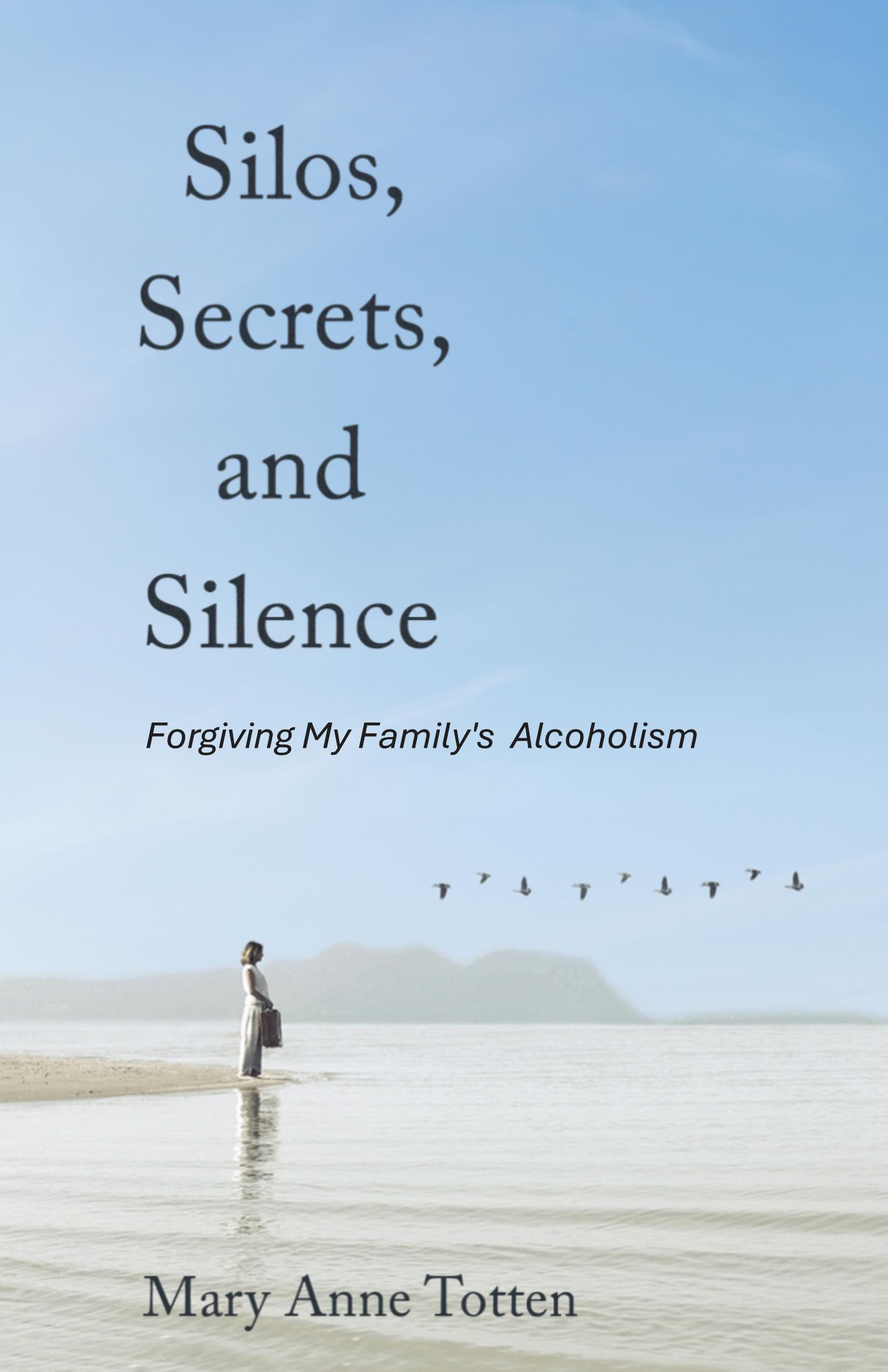
SILOS, SECRETS, AND SILENCE
Mary Anne Totten
Musings from Present Day
My family lived by the code of covert secrecy. Even
now my brother, Bob, my sister, Kate, and I may see
each other once a year and talk on the phone every
two or three months. We generally don’t have much to
talk about. We don’t keep secrets from one another
intentionally.
Only twice did my father explicitly tell me not to share
something with my brother and sister, and in both cases
that had to do with gifts. First, I was thirty-four years old
when he brought Grandmother Totten’s dishes in a box
and put them in my garage without asking my permission.
The second time, during a phone call, he announced that
he was sending the gift of a $15,000 Bösendorfer grand
piano. He had never seen my second-floor walk-up apartment
and had no idea of the size of my living room.
The previous Thanksgiving, Dad had taken me to a
music store in Kansas City to show me the piano, and I
had an opportunity to try it out. The piano was beautiful
with a mellow sound and a soft touch. I would never have
imagined he would give me this sort of gift. Before I could
comprehend the situation, the piano was en route from the
distribution center in Jasper, Indiana, to Boston, Massachusetts.
When the piano arrived, a crane was required to lift it to the
second floor and maneuver it through the window. Seeing a
grand piano dangle from a crane like a whirligig about to fall
was a sight to see. Dad said he wanted to give me my inheritance
before he died, and he didn’t want to put these things in a will.
He hadn’t given my siblings something equivalent, so he burdened
me with the gifts and the need to keep them secret. The dishes
could be kept out of sight in the box, but the piano was harder
to hide.
I was the oldest, but I never felt that I was his favorite.
There may have been competition between Bob and Kate for
Dad’s attention. Perhaps he was planning to give them special
gifts, but no one ever told me. I was shocked when I learned
that Dad wanted to give me an expensive piano.
Our family had a quiet understanding that we did
not reveal much of ourselves to each other. We lived our
individual lives, loosely bound by being family but staying
in our isolated compartments, like silos on a Kansas farm.
I worked hard to keep my grain from rotting, but I have
my own secrets.
Mother died in 2015.
She’s been gone for almost ten years at the time of
this writing. It feels so much longer than that. Perhaps it’s
because I have been contemplating writing about my life
with her for so many years.
My family was plagued by the demons of alcoholism,
including minimization, secrecy, collusion, invisibility, and
abandonment. These demons cut me to the core and have
lingered with me since I was fifteen years old.
My big secret, which I kept for years, was that I wished
my mother was dead. I was shocked when, on May 18, 2016,
those words appeared on the page while I was writing an early
draft of this book, less than a year after she died at the age
of ninety-four. I had been preparing for that day for almost sixty
years. I had often wondered whether I would care if Mother died,
or how I would feel if I were at her bedside when she was dying.
Our relationship was a sixty-year conspiracy of silence. It wasn’t
so much that we kept secrets from one another, but rather that
we didn’t talk, other than about the weather or social activities
we were involved in.
Today I can decidedly say that the estrangement
within my family was related to alcoholism. Even though
Mother got sober when she was fifty-one years old and
didn’t drink for the last forty-three years of her life, she
was still an alcoholic. The personality traits remained. I had
pined for a closer relationship with Mother and thought
if she confessed to her alcoholism, closeness would
magically happen. For years I wished for reconciliation
but became disillusioned, ultimately believing we could
never achieve harmony. Forgiving Mother and obtaining
an apology from her for all the ways her alcoholism
negatively impacted me and our family would set things
right between us. But that never happened, and I was left
to make sense of the fallout on my own.
I discovered I had lived with the false assumption that
alcohol severed our family, and alcoholism was the overt
factor in my parents’ divorce in 1960. But alcoholism was
only a symptom of the bigger and more encompassing
problem of noncommunication and secrecy, which led
to feelings of invisibility and micro-abandonment. These
were the more covert factors that pushed me away from
my family.
Eventually, I had to forgive Mother. We were able to
achieve a small degree of reconciliation a couple of years
before she died. For my whole life, I was at the mercy of my
family’s personality quirks. I felt angry and alienated from
the family unit, but I held on to the notion life must be
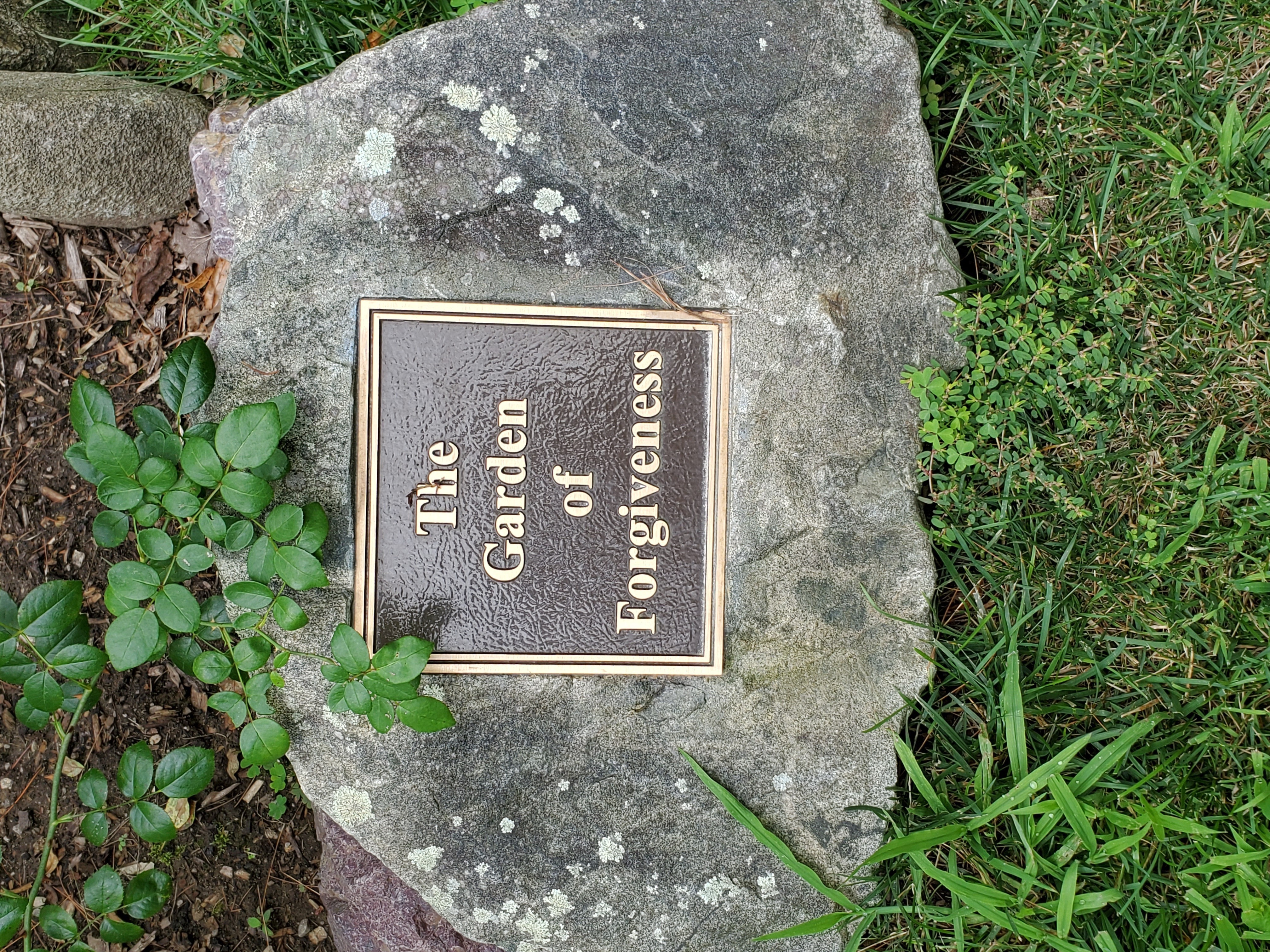
better than what I was given. When I explored forgiveness,
I found that it’s complex and ongoing. I thought all I had
to do was forgive my mother.
In a relationship where forgiveness is needed, both the
perpetrator and the recipient are involved. I was expecting
an apology from Mother, but I also had to forgive myself
for the role I played in the breakdown of our relationship.
I became aware over time that I had a hand in the distance
I felt from the family.
I’ve written this book to finally write the story of growing
up with my mother, but in the process, I’ve come to understand
the core lesson I’ve learned is about forgiveness.
.jpeg)